Overview
What NSFNET was, the innovations it introduced, and how it passed into commercial hands.
On this page
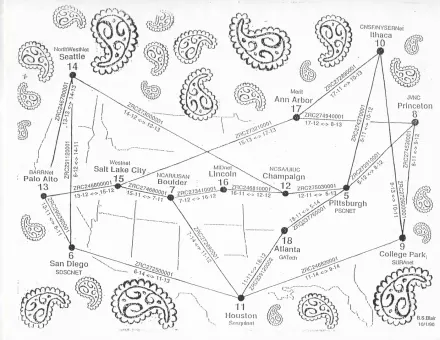
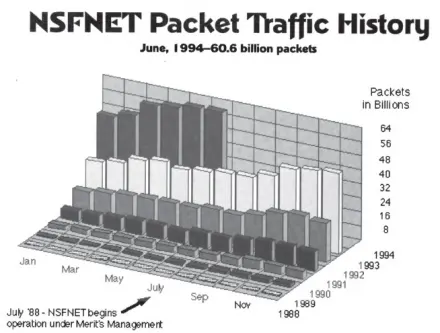
The National Science Foundation Network (NSFNET) was a groundbreaking wide-area network established by the National Science Foundation (NSF) in 1985, becoming operational in 1986. It quickly replaced ARPANET as the primary government network linking universities and research facilities across the United States. NSFNET served as the backbone of the early internet until its decommissioning in 1995, when it transitioned to the commercial internet infrastructure we know today.
NSF.net was registered on November 5, 1986, the creation date its domain record still carries. That makes it the third .net domain ever registered. The .net domain was part of the initial set of generic top-level domains defined in RFC 920 (October 1984) and was included in the first implementation of these domains.
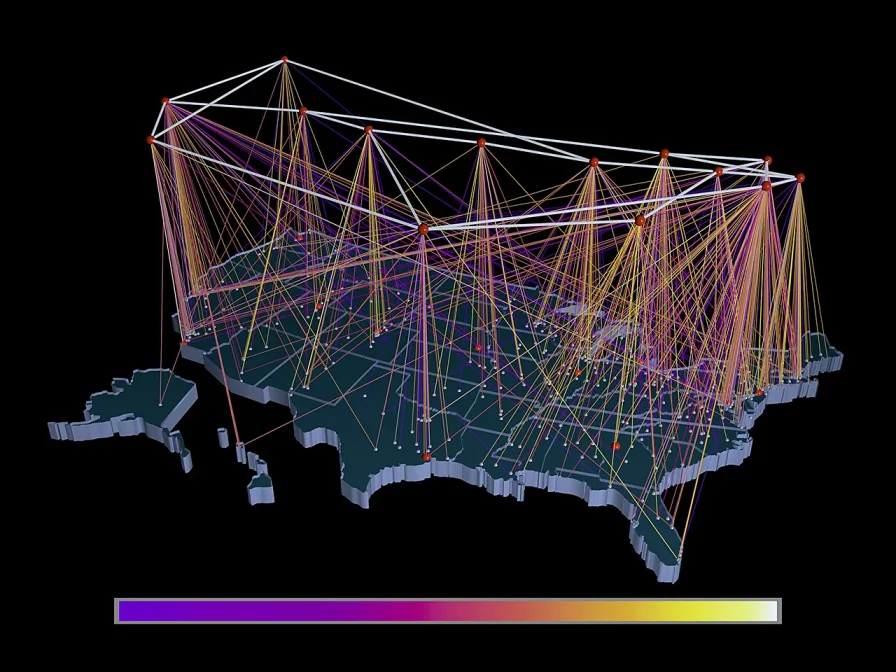
NSFNET represented a critical shift in networking philosophy, moving from military and defense applications toward academic and research purposes. This transition democratized network access and laid the groundwork for the explosive growth of the internet in the 1990s. The network’s architecture, consisting of a high-speed backbone connecting regional networks, established the hierarchical model that continues to define internet infrastructure today.
Technical Innovations
NSFNET pioneered several technical innovations that remain fundamental to modern networking:
- Distributed Network Operations Center (NOC): Unlike previous networks with centralized management, NSFNET implemented a distributed NOC model that improved resilience and responsiveness.
- Routing policy registries: The NSFNET Routing Arbiter’s policy database established the practice of publishing machine-readable routing policy, a lineage running through RIPE-181 to the Routing Policy Specification Language (RFC 2622, 1999) that still governs internet routing registries today.
- Traffic analysis tools: The NSFNET team created sophisticated tools for analyzing network traffic patterns, establishing the field of internet measurement and informing network capacity planning.
- Peering arrangements: NSFNET established formal peering relationships between networks, creating the model for the interconnection agreements that now form the basis of internet traffic exchange.
These innovations are well-documented in Merit Network’s NSFNET history collection, which includes technical papers, presentations, and historical photographs from the project.
Government to Commercial Transition
The transition from NSFNET to the commercial internet represents one of the most successful technology transfers in history. This carefully orchestrated process included:
- The Scientific and Advanced-Technology Act of October 23, 1992, which amended the NSF Act to permit support for networks used substantially for purposes beyond research and education
- Creation of Network Access Points where commercial providers could exchange traffic, the awards going to Sprint, MFS Datanet, and Bellcore, the last on behalf of Ameritech and Pacific Bell
- Establishment of the Routing Arbiter service to coordinate routing policies between competing commercial networks
- Development of the very high-speed Backbone Network Service (vBNS) to support advanced research applications while commercial providers served general internet traffic
- A phased transition that ensured no disruption to internet connectivity for educational and research institutions
The technical history of NSFNET from IBM (one of the original partners in the network) provides a detailed account of this transition, which has been studied as a model for government-to-private sector technology transfer.
Objections and Oversight
The transfer was not universally admired while it was under way. In September 1990 Merit, IBM and MCI formed Advanced Network & Services, a non-profit corporation that took over much of the engineering and operation of the backbone under Merit’s agreement with the Foundation. In May 1991 ANS created a for-profit subsidiary, ANS CO+RE Systems, to carry commercial traffic and traffic that mixed commercial with research and educational use. Paying customers were now being served over a network the government had built, and competitors argued that the arrangement gave the partnership an advantage no one else could obtain.
Congressman Rick Boucher, who chaired the House Subcommittee on Science, held a hearing on the management of NSFNET on 12 March 1992, and afterwards asked the Foundation’s Inspector General to examine what it had raised: the upgrade to T3 without re-bidding the award, the privatization of the backbone, commercial use of it, conflicts of interest between contractor and subcontractor, and whether the Foundation had properly overseen its own agreement.
The review appeared in April 1993. It was broadly favorable. “In general we were favorably impressed with the NSFNET program and staff,” it says, and it found the original award to Merit reasonable, the shared use of the routers and lines consistent with the agreement, and the decision to permit some commercial traffic “not unreasonable” given what the Foundation was trying to achieve. It made recommendations too: that the infrastructure pool, the project income returned to improving the network, be properly funded and equitably distributed; that Merit audit ANS and CO+RE at its own expense once the agreement ended; and that other providers be offered access to the T3 network on the same terms as CO+RE.
Current Stewardship
My name is Dave Levine, and I acquired NSF.net on March 30, 2022. I’m incredibly honored to be the steward of this domain, a unique digital asset and an essential piece of internet history that I intend to preserve and maintain for years to come.
As custodian of this historic domain, I recognize its significance in the development of what would become the modern internet. This website serves as both a historical record and a tribute to the visionary work of the scientists, engineers, and policymakers who created NSFNET and helped transform global communications.
Corrections are always welcome. If you have a document, a report, an RFC, anything that says otherwise, send it along and I’ll update accordingly.
Cite this page
NSF.net. “Overview.” NSFNET: A History of the National Science Foundation Network. Last modified July 30, 2026. https://nsf.net/about.