Timeline
The course of the project from the 1985 funding decision to the backbone’s retirement in 1995.
Published: Updated: Read: 4 min
On this page
Early Years (1985-1986)
- May 1985: NSF releases “A Plan for InterConnecting Institutions with High Performance Computing Capabilities,” outlining the vision for NSFNET
- June 1985: NSF issues solicitation for supercomputer center proposals
- November 1985: NSF awards grants to establish five supercomputing centers at Princeton, Cornell, the University of California San Diego, the University of Illinois Urbana-Champaign, and the University of Pittsburgh
- December 1985: Dennis Jennings makes the pivotal decision to use TCP/IP protocols for NSFNET, aligning with ARPANET standards, as detailed in the NSF Special Report on the Internet
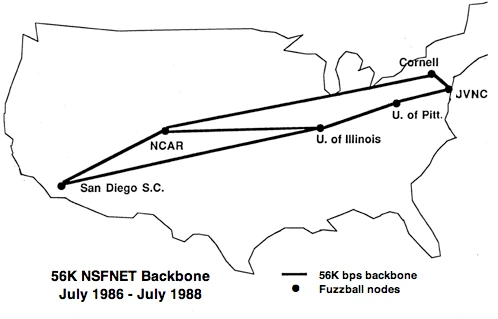
- April 1986: Initial 56 kbps links established between supercomputer centers
- July 1986: NSFNET backbone becomes fully operational, connecting all five supercomputer centers
- June 1986: Stephen Wolff succeeds Dennis Jennings as NSF Program Director for Networking
- November 5, 1986: NSF.net domain registered, becoming the 3rd .net domain in history
Network Expansion (1987-1991)
- February 1987: NSF issues solicitation for management and operation of an expanded NSFNET backbone
- May 1987: NYSERNet (New York State Education and Research Network) becomes the first regional network to connect to NSFNET
- November 1987: NSF awards backbone management contract to Merit Network, partnered with IBM and MCI, establishing what the Merit Network describes as a groundbreaking public-private partnership
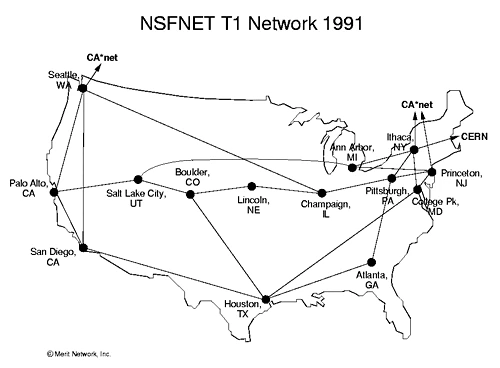
- July 1988: New 1.5 Mbps (T1) backbone becomes operational, a 24-fold increase in capacity
- November 2, 1988: The Morris Worm becomes the first major internet security incident, prompting regional networks to disconnect from the backbone for several days during the cleanup
- February 1989: The Federal Research Internet Coordinating Committee expands international connections to include Australia, Israel, Japan, Mexico, and the UK
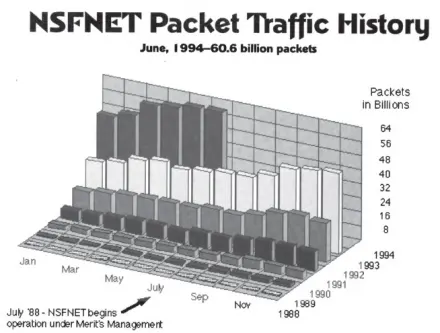
- May 1989: NSFNET reaches 100 million packets per day milestone
- August 1989: First deployment of Border Gateway Protocol (BGP) for inter-network routing
- March 1990: ARPANET officially decommissioned, with NSFNET taking over as primary research network
- 1990: NSF issues its International Connections Management (ICM) solicitation, consolidating the engineering of links between American and overseas research networks under a single manager
- January 1991: NSFNET traffic exceeds 1 billion packets per month
- May 1991: ANS creates ANS CO+RE Systems, a for-profit subsidiary carrying commercial traffic over the same infrastructure as the backbone service
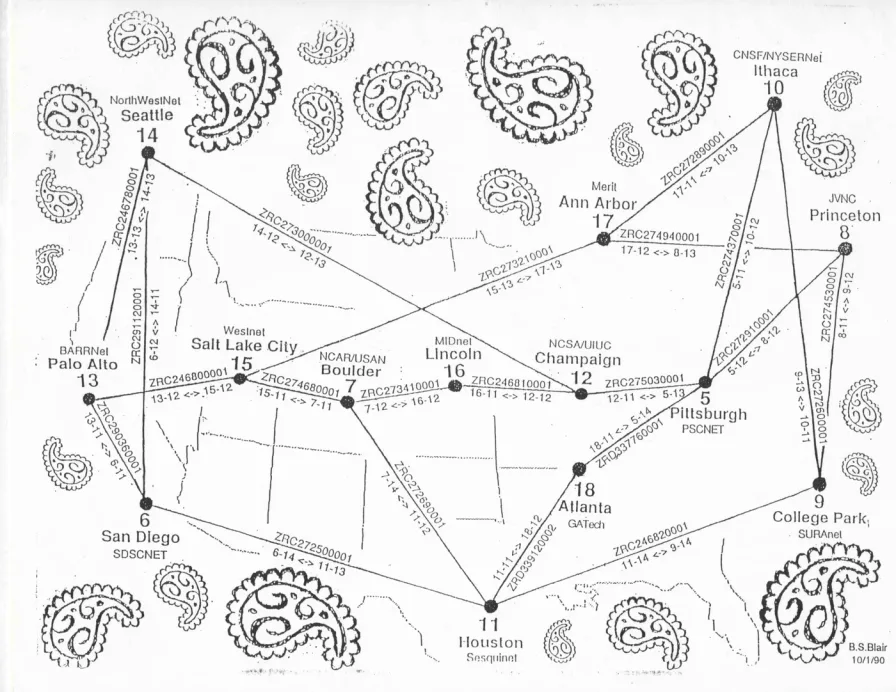
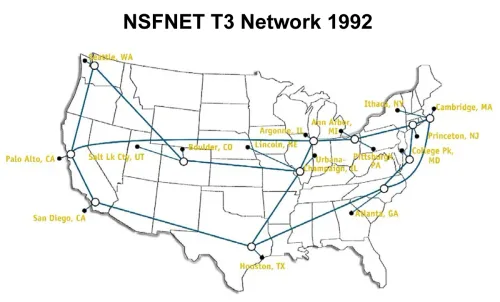
- November 1991: The sixteenth and final T3 (45 Mbps) backbone site is completed and production traffic begins moving to the new service, operated for NSFNET by Advanced Network & Services, a 30-fold increase in capacity that concludes in early 1992
- December 1991: U.S. High Performance Computing Act signed into law, providing continued funding for advanced networking
Decline of NSFNET (1991-1995)
- August 1991: World Wide Web publicly announced by CERN, creating new demands for network capacity
- March 12, 1992: The House Subcommittee on Science holds a hearing on the management of NSFNET, examining the T3 upgrade, commercial use of the backbone, and the Foundation’s oversight of its own agreement
- May 1992: Internet Society (ISOC) formed to provide leadership in internet standards and policy, as documented in the Internet Society’s historical archives
- October 23, 1992: The Scientific and Advanced-Technology Act is signed into law, amending the NSF Act to permit support for networks used substantially for purposes beyond research and education
- April 1993: The Foundation’s Inspector General publishes its review of NSFNET, finding the program soundly run and recommending changes before the re-solicitation
- June 1993: NSF creates InterNIC to provide directory, database, and domain registration services
- September 1993: NSF releases “NSFNET Backbone Services Transition Plan” outlining the shift to commercial providers
- February 1994: NSF solicits proposals for Network Access Points (NAPs) to facilitate traffic exchange between commercial networks
- Early 1994: Network Access Point awards go to Sprint, MFS Datanet, and Bellcore (the last representing Ameritech and Pacific Bell), alongside the Routing Arbiter award to Merit with USC’s Information Sciences Institute, as recorded in Merit’s account of the transition
- October 1994: Very high-speed Backbone Network Service (vBNS) contract awarded to MCI for continued support of research applications
- January 1995: NSFNET begins phased decommissioning process
- April 30, 1995: NSFNET backbone service officially ends, with traffic transitioning to commercial providers, as detailed in Living Internet’s NSFNET history
- June 1995: NSF implements new Acceptable Use Policy removing restrictions on commercial internet traffic
- October 24, 1995: The Federal Networking Council passes a resolution formally defining the term “Internet” as the global information system using TCP/IP
International Expansion
- 1987: First international connections to Canada (via Cornell) and France (via INRIA)
- 1988: NORDUnet connects the Nordic countries (Denmark, Finland, Iceland, Norway, and Sweden) to NSFNET, becoming the first European research network to adopt TCP/IP and join the backbone
- 1989: Connections established with Australia (AARNET), Japan (WIDE), and the United Kingdom (JANET)
- 1990: European academic networks connect via EARN (European Academic Research Network)
- 1991: Central American connectivity develops around the University of Costa Rica and its national research network, CRNet, with the NSF’s ICM program providing the interconnection point in the United States
- 1994: African connections begin with Tunisia, Egypt, and South Africa joining the global internet
Topics#Infrastructure#Policy
Cite this page
NSF.net. “Timeline.” NSFNET: A History of the National Science Foundation Network. Last modified July 30, 2026. https://nsf.net/timeline.