Internet Backbone
The backbone service itself: its architecture, its capacity, and how its traffic was managed.
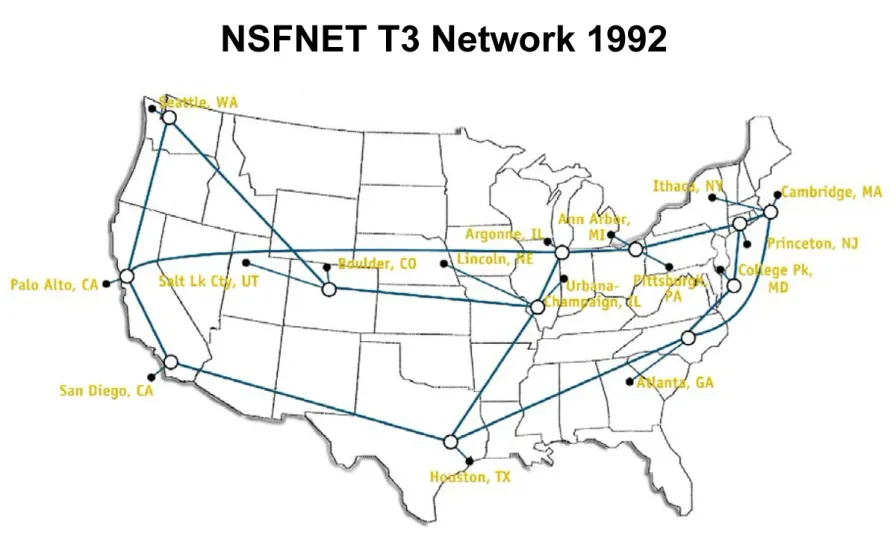
The National Science Foundation awarded the agreement for a high-speed NSFNET backbone to Merit Network, working with IBM and MCI, in November 1987. The T1 backbone went into service eight months later, in July 1988, linking thirteen sites at 1.544 Mbps (million bits per second) and carrying 152 million packets a month. Merit’s final report on the partnership counts more than 170 networks attached at that point. A T3 backbone at 45 Mbps followed in 1991, linking sixteen sites and more than 3,500 networks. Today many companies operate their own high-capacity backbones, and all of them interconnect at various NAPs around the world.
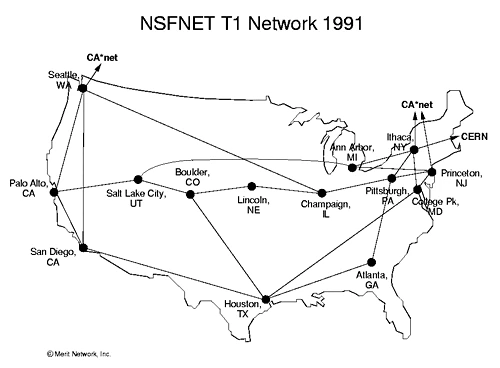
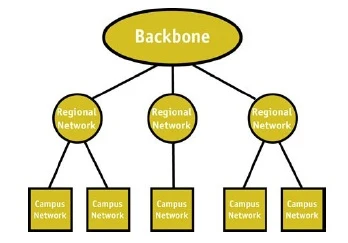
The NSFNET backbone represented a revolutionary approach to network architecture. Rather than building a single monolithic network, the NSF created a hierarchical system with the high-speed backbone connecting regional networks, which in turn connected individual institutions. This design proved highly scalable and became the model for the modern internet.
Technical Architecture
The backbone consisted of dedicated leased lines connecting specialized routers (initially Cisco AGS+ routers, later upgraded to IBM RT systems running custom routing software). The network employed a three-tiered structure:
- Backbone Network: The high-speed national infrastructure connecting supercomputer centers and regional network hubs
- Regional Networks: Mid-level networks serving specific geographic regions (like NYSERNet, SURAnet, and BARRNet)
- Campus Networks: Individual institutional networks connecting to their regional provider
The first backbone was routed by Fuzzballs: DEC PDP-11s running software written by David Mills at the University of Delaware, five of them at the supercomputer centers, joined by 56 kbit/s circuits. Mills, whose own account records the machines and what became of them, remembers the network as “gloriously overloaded,” and that congestion is what prompted the expansion. Merit’s proposal for that expansion divided the problem into three: the packet-switching nodes, which it called the Nodal Switching Subsystem; the circuit switches joining those nodes, the Wide Area Communications Subsystem; and a network management system to watch the whole of it. A T1 node was nine IBM RT systems working as one; the T3 nodes that replaced them did the same work in a single RS/6000.
This hierarchical design distributed management responsibilities and costs while maintaining coordinated routing and addressing. The architecture proved remarkably scalable, accommodating exponential growth throughout NSFNET’s operation.
Merit documented the arrangement as it was built. RFC 1093 (February 1989) describes the interface between the backbone and the regional networks attached to it: an internal routing protocol within the core, the Exterior Gateway Protocol for exchanges with the regionals and peer networks, and policy-based filtering to keep those exchanges consistent. Routing between NSFNET and the Defense Data Network (MILNET and ARPANET) was documented separately in RFC 1133 (November 1989), which records the move from gateway-based routing to direct Mailbridge connections between the two administrative domains.
Traffic Management Innovations
The backbone’s management introduced innovative approaches to network operations, including sophisticated traffic monitoring and analysis tools. These tools helped identify bottlenecks and optimize performance, establishing practices that remain central to network management today.
The NSFNET team developed custom software for traffic analysis, creating the first comprehensive internet measurement infrastructure. These tools collected and analyzed routing tables, traffic volumes, and packet loss statistics, enabling data-driven capacity planning and network optimization.
The team also pioneered the concept of traffic engineering, the practice of optimizing network performance through strategic routing decisions. These techniques became essential as network traffic grew exponentially and continue to be fundamental to internet operations today.
Cite this page
NSF.net. “Internet Backbone.” NSFNET: A History of the National Science Foundation Network. Last modified July 30, 2026. https://nsf.net/projects/backbone.