Mosaic
The NCSA browser that made the web legible to a general audience.
On this page
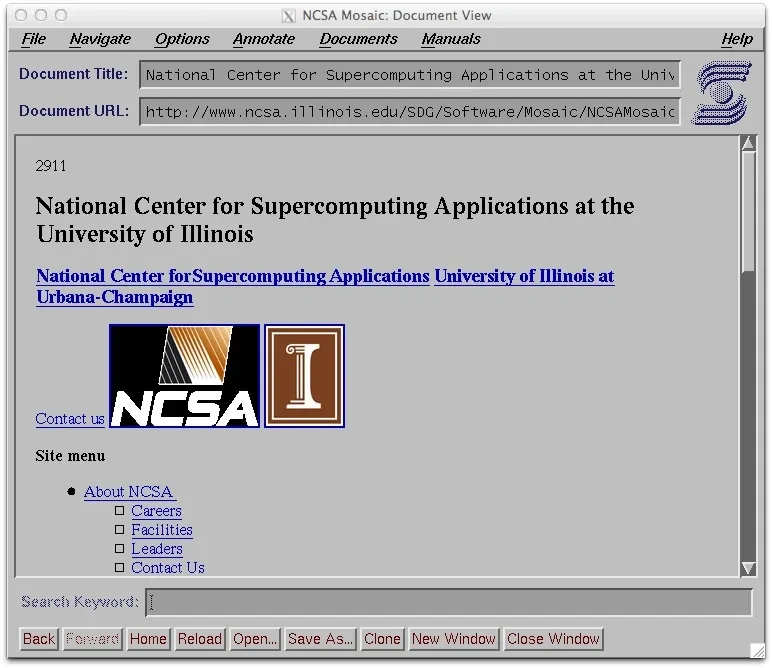
Mosaic was the first freely available Web browser to allow Web pages to include both graphics and text, developed in 1993 by students and staff working at the NSF-supported National Center for Supercomputing Applications (NCSA). In less than 18 months, NCSA Mosaic became the Web “browser of choice” for more than a million users and set off exponential growth in Web servers and users.
Led by Marc Andreessen and Eric Bina, the Mosaic development team created a user-friendly interface that made the web accessible to non-technical users. The browser’s ability to display inline images alongside text transformed the web from a text-based medium to a rich multimedia platform.
Technical Innovations
Mosaic introduced several technical innovations that defined the modern web browsing experience:
- Inline graphics: Pioneered the display of images directly within web pages rather than requiring separate windows
- Graphical user interface: Created an intuitive point-and-click interface accessible to non-technical users
- History tracking: Introduced the ability to navigate backward and forward through visited pages
- Multimedia support: Pioneered integration with external media viewers for audio and video content
- Cross-platform availability: Developed for Unix/X Window System, Microsoft Windows, and Macintosh, making the web accessible across computing platforms
These features established the fundamental user interface paradigms that continue to define web browsers today. Mosaic’s clean, intuitive interface made the web accessible to non-technical users, catalyzing its rapid adoption beyond academic circles.
Legacy and Impact
Mosaic’s influence extended far beyond its user base. Its code and design principles directly influenced Netscape Navigator, and subsequently, virtually all modern web browsers. The browser’s support for forms, bookmarks, and a consistent user interface established conventions that remain standard in web browsers today.
The Mosaic team’s innovations were commercialized through Netscape Communications Corporation, founded by Marc Andreessen and Jim Clark in 1994. Netscape Navigator dominated the early commercial web, and its codebase eventually became the foundation for Mozilla Firefox. Even Microsoft’s Internet Explorer, which later dominated the browser market, was initially based on licensed Mosaic code.
By making the web visually appealing and easy to navigate, Mosaic transformed it from a specialized academic tool into a mass medium. This transformation drove demand for internet connectivity, accelerating the transition from NSFNET to the commercial internet.
Learn more about Mosaic’s development and impact at the NCSA’s Mosaic project history.
Cite this page
NSF.net. “Mosaic.” NSFNET: A History of the National Science Foundation Network. Last modified July 29, 2026. https://nsf.net/projects/mosaic.