Network Information Services
The directory, naming, and routing registry services that made the network usable.
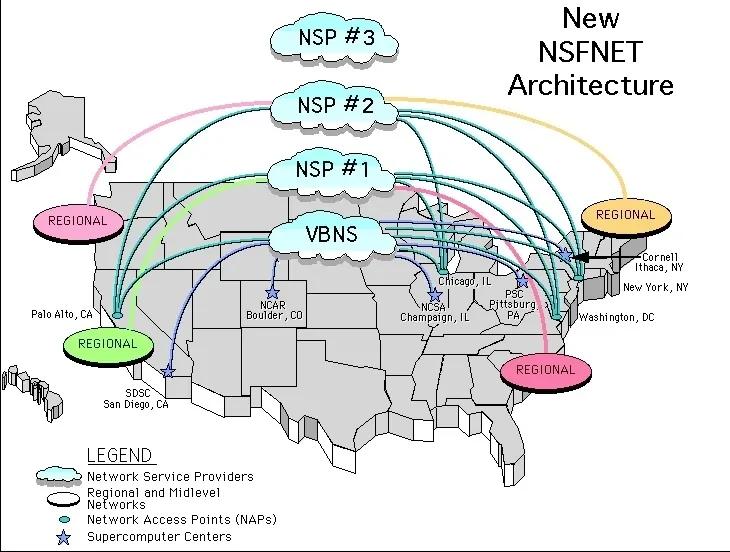
NSFNET catalyzed the development of essential network information services that provided coordination functions for the growing internet. These services established models for internet governance and resource management that continue today.
Domain Name System (DNS)
While DNS was initially developed under DARPA funding, NSFNET drove its widespread adoption and expansion:
- In 1987, NSF funded SRI International to establish the first DNS Network Information Center (NIC)
- The NIC managed the root zone and coordinated domain registrations for .com, .org, .net, .edu, and .gov domains
- In 1993, NSF created InterNIC to provide enhanced domain registration services
- These services established the model for domain name management later adopted by ICANN
Routing Registries
NSFNET pioneered the concept of routing registries to coordinate routing policies between networks:
- The NSFNET Routing Arbiter Database (RADB) was established in 1994 to maintain routing policy information
- This database enabled consistent routing between the growing number of commercial networks
- The RADB model was later adopted by regional internet registries worldwide
- Modern internet routing coordination still follows principles established by the NSFNET Routing Arbiter
Directory Services
NSFNET supported the development of internet-wide directory services:
- X.500 directory services were implemented across NSFNET to provide a “white pages” function
- The Lightweight Directory Access Protocol (LDAP) was developed to make these services more accessible
- These directory technologies continue to be fundamental to enterprise networks today
These network information services established essential coordination functions for the internet ecosystem, creating models for technical coordination that balanced centralized management with distributed control.
The Internet Society marked the system’s thirtieth anniversary with an account of its origins and of the coordination that has kept it running since.
Publications
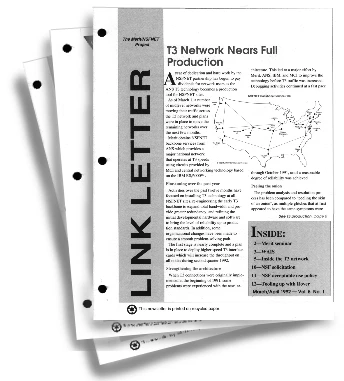
Merit published the Link Letter for the NSFNET community from 1988, reporting the state of the backbone, the progress of the T1 and T3 upgrades, and how to reach the services that ran on it. It went to subscribers on paper and, later, over the network itself.
Cite this page
NSF.net. “Network Information Services.” NSFNET: A History of the National Science Foundation Network. Last modified July 30, 2026. https://nsf.net/projects/network-information-services.